Showing posts with label vision loss. Show all posts

Wednesday, 15 June 2016

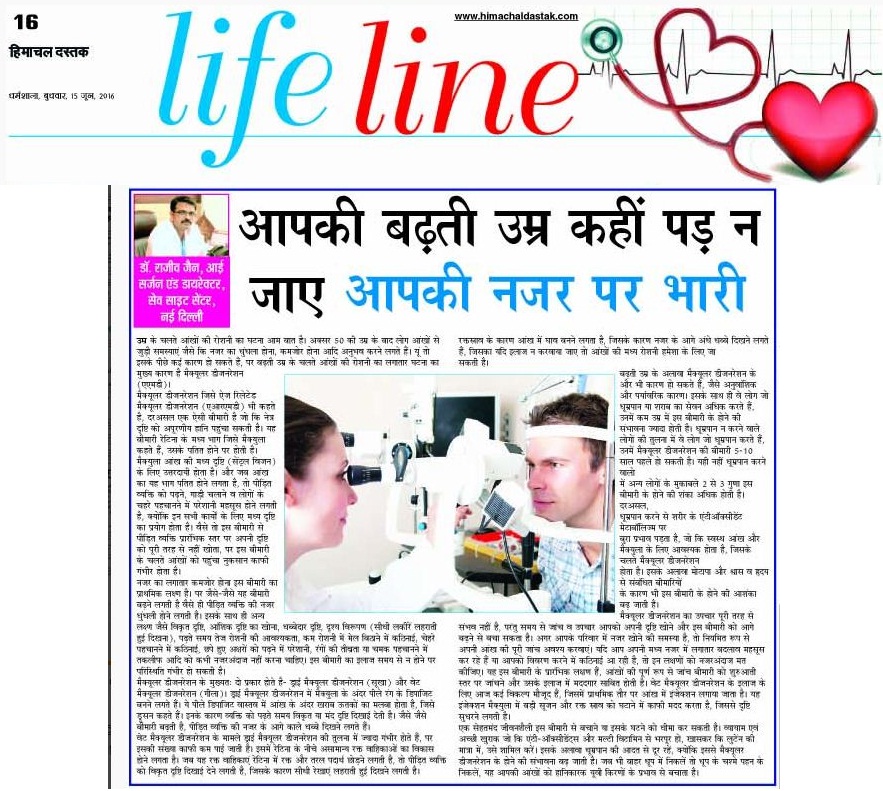
Macular Degeneration can cause ireeparable Loss Of Vision

Age Related Macular Degeneration‬ (ARMD‬) also called as Macular Degeneration or AMD is a disease that can cause Irreparable Loss Of Vision‬. This problem occurs when the central part of the ‪‎retina‬, known as Macula degenerates. To know more about this problem, read the below enclosed article of mine that appeared in today's Himachal Dastak.

Wednesday, 1 June 2016

Age Related Macular Degeneration may cause irrepairable Vision Loss

Age Related Macular Degeneration (ARMD) also known as Macular Degeneration or AMD is a disease that can cause irreparable vision loss. This problem occurs when the central part of the retina, known as Macula degenerates. The macula is responsible for central vision of the eye and when it deteriorates, the affected person starts facing problems while reading, driving or recognising faces, as these activities involves central vision. Although, a person suffering from this disease doesn’t completely loses his/her vision in the early stage itself, but the damage caused is quite significant.
 

Monday, 30 May 2016

Age Related Macular Degeneration (ARMD) : The biggest reason behind Vision Loss post the age of 50

Weakening of Eyesight‬ or loss of vision is a factor synonymous to aging. As one crosses the age of 50, problems like ‪‎Blurred Vision‬, Weakening Of Eyesight‬ etc. becomes a common phenomenon. Though, there can be a lot of reasons behind this, but one of the most common cause of Vision Loss‬ while aging‬ is ‪‎Age Related Macular Degeneration‬ (ARMD). To know more about this disease, read the below enclosed article of mine that appeared in today's Dainik Jagran.

Tuesday, 2 February 2016

Slightest changes in the vision should never be ignored, it can be something big

Retinal detachment is a very serious eye disorder in which the retina separates or peels away from the tissue around it. If you observe flashes of light or floaters in your vision, or darken side vision, don't delay visiting a retina specialist as these might be the symptoms of retinal detachment. This condition if not treated timely can lead to vision loss or blindness.

Thursday, 13 August 2015

Your child might be suffering from a very rare but difficult to diagnose disease


Best’s disease, also known as Vitelliform Macular Dystrophy, is the loss of central vision of the eyes and it is an inherited form of macular degeneration. In this disease, the central part of the retina known as macula, which is responsible for the fine visual and color perception, gets affected. It causes problems with your central vision, but does not lead to total loss of sight and is not painful. 

During the initial stage, a bright yellow color cyst gets formed under the retinal pigment epithelium (RPE) beneath the macula. Despite its presence, the visual acuity remains normal and the side vision usually remains unaffected.

In many people, who are suffer from Best’s disease, the cyst breaks eventually and the fluid and yellow particles of the cyst gets spread throughout the central part of the retina .i.e. macula, causing further vision loss.


It is usually diagnosed during childhood or adolescence. It causes changes at the back of the eye between the ages of 3 to 15. Sometimes a child may notice a change in their vision and then an eye test confirms that they have retinal changes which could indicate Best disease. However, even though someone who has Best disease may not develop vision problems at an early age but later in life around the age of 40 these problems can be seen.                                                                                                                                                                                                                                                                                                                                                                                                                                                                                                                                                     
This disease does not always affect the vision of both the eyes equally. Many people retain the central vision in one eye.

Best’s disease is genetically passed through families. It is hereditary in nature.Currently, there is no treatment for Best’s disease. Researchers are still trying to understand the cause of this disease.