It is true that Glaucoma can be a silent killer for your eyes but awareness and early detection can help prevent Vision Loss.
So, if you experiencing symptoms of Glaucoma, get yourself diagnosed at
the earliest. Also, even if your eyes are healthy, then also undergo regular eye checkups to stay healthy.
Showing posts with label Kala Motia (Glaucoma). Show all posts
Tuesday, 17 May 2016
Monday, 16 May 2016
Treating Glaucoma
There are times when primary course of treatment for Glaucoma,
i.e. medicine (eye drops) and laser surgery is not possible. In that
case, the conventional surgery is the only option. In this method, a new
opening is made in the eye to ease the flow of fluids which
consequently lowers the pressure. Depending upon the condition, the
doctor may use one or combination of method to cure Glaucoma.
Sunday, 15 May 2016
Detecting Glaucoma in the Early Stage can help in Better Treatment
If detected timely, Glaucoma can be treated using medicine, Laser Surgery or the conventional Glaucoma Surgery.
In early stages, Glaucoma can be treated through eye drops which helps
in lowering the pressure. The other way to cure this disease is laser
surgery in which the fluid built up is eased by draining it out.
Friday, 13 May 2016
Diagnosing Glaucoma
Glaucoma
is usually more common in people above 40 years of age, but can also
affect people in young age. People having family history of Glaucoma are
at a much higher risk of developing this disease. Also, people with
problems like High Blood Pressure and diabetes or who have been taking steroids for a long time are prone to it.
The best way to protect our eyes from this dangerous disease is Regular Eye Examination. During diagnosis, an ophthalmologist examines the eyes and optic nerves to see their condition. Doctor may also perform a procedure called tonometry to check the pressure in eyes. Other than that, Eyesight Checkup and visual field test are done to check for any loss of vision.
Thursday, 12 May 2016
Identifying symptoms of Glaucoma early, can help preventing complete loss of vision
Glaucoma, often referred as ‘sneak thief of vision’, does not show any clear sign till the patient is on verge of losing eyesight.
In the initial phase, there is no pain or difficulty is seeing. But as
the condition progresses, the patient gradually starts losing peripheral
vision.
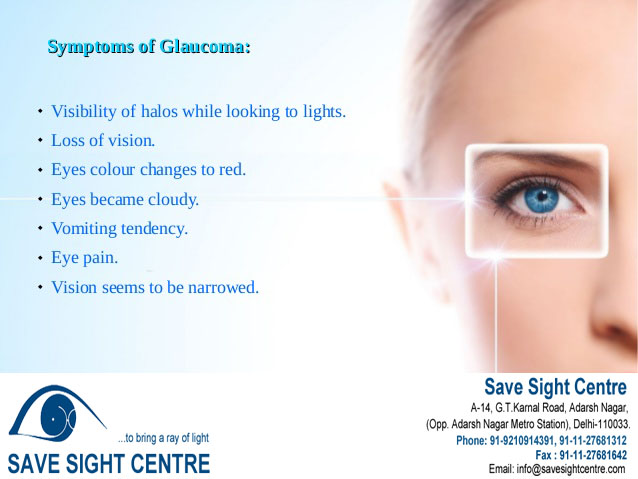
Some symptoms that may be pointing towards Glaucoma are difficulty in
seeing in dark places, frequent changes in eye power, narrowing of field
of vision, blurred vision, seeing halos around light, pain and redness in eyes, nausea, change in the color of iris, watery eyes, double vision etc.
Tuesday, 10 May 2016
Why do one develop Glaucoma?
The main reason behind development of Glaucoma
is increase in intra-ocular pressure (the pressure of fluid in our
eyes). Excessive rise in pressure strangles the nerve fibres, due to
which they start dying. As a result, progressive damage occurs which may
lead to permanent blindness.
But it is not the sole reason; Glaucoma can occur even if the intraocular pressure is normal. This is called Low-Tension or Normal Tension Glaucoma, in which optic nerve damage may occur due to other reasons. Though rare, Glaucoma can also be caused due to a chemical or blunt injury, eye infections, severe eye inflammation or blockage of blood vessels in eyes.
Monday, 9 May 2016
Glaucoma can cause permanent blindness: Know about it
Glaucoma is one of the leading causes of blindness
all over the world. Though people of every age group are equally
susceptible to developing Glaucoma, for elderly, the chances are even
higher.
Glaucoma is a condition in which the optic nerve, which transmits the images formed on retina to the brain, starts getting damaged. Once it is completely impaired, the brain stops receiving the images. As a result, the affected person loses his/her ability to see.
Saturday, 31 October 2015
A healthy body makes for healthy eyes too!
Our eyes health depends
largely upon our body's overall health. Having a good diet accompanied
with regular exercise helps increasing body's blood circulation, which
ultimately lowers down pressure in the eyes. Excessive pressure on the
eyes is a major factor that contributes to Glaucoma, so exercising
regularly can be extremely beneficial for your eyes.
Thursday, 23 July 2015
Watch out for symptoms of Glaucoma (Kala Motia)
Glaucoma also known as Kala Motia is one of the serious conditions of the eye in which fluid pressure inside the eyes damages the optic nerve. It causes excessive damage to the optic nerve which eventually results in blindness. It can be treated through medicines, laser surgery or operative surgery depending upon the nature and severity of each case.
Noticeable signs of the Glaucoma:-
Doubling of vision, change in the colour of iris, intense pain, redness of the eye, headache, nausea, vomiting, watery eyes etc.
Strong risk factors include:-
Age, past injuries to the eyes, thin cornea, very severe near eye sight, family history of glaucoma, African ancestry, diabetes, use of steroid etc.
If you are facing any one of these symptoms, contact an eye specialist for a complete test.
Subscribe to:
Posts (Atom)