Showing posts with label glaucoma. Show all posts

Thursday, 7 July 2016

Neglecting Glaucoma can lead to permanent loss of Peripheral Vision

If one is suffering from Glaucoma‬, the best "Cure‬" for Tunnel Vision‬/ Peripheral Vision Loss‬ is prevention. If eye drops are prescribed, one must take the glaucoma medication regularly to control high eye pressure, or there is always a risk of permanent optic nerve damage and development of blind spots in the visual field. Left untreated, glaucoma can lead to permanent loss of peripheral vision and even Blindness‬.

If one have permanent loss of peripheral vision, the one should consider visiting a Low Vision Specialist‬ who can advise about special eye wear or optical devices that might help with mobility problems caused by tunnel vision.
Also, be aware that reduced peripheral vision may affect the ability to drive safely. A low vision specialist can tell about the extent of the peripheral vision loss and whether the remaining vision meets the legal requirement for a valid driver's license or not.

Tuesday, 17 May 2016

Glaucoma: A silent vision killer. How to prevent oneself from becoming a victim of this disease

It is true that Glaucoma‬ can be a silent killer for your ‪‎eyes‬ but awareness and early detection can help prevent Vision Loss‬. So, if you experiencing symptoms of Glaucoma, get yourself diagnosed at the earliest. Also, even if your eyes are healthy, then also undergo regular eye checkups‬ to stay healthy‬.

Monday, 16 May 2016

Treating Glaucoma

There are times when primary course of ‪treatment for Glaucoma‬, i.e. medicine (eye drops) and laser surgery is not possible. In that case, the conventional surgery is the only option. In this method, a new opening is made in the eye to ease the flow of fluids which consequently lowers the pressure. Depending upon the condition, the doctor may use one or combination of method to cure ‪‎Glaucoma‬

Sunday, 15 May 2016

Detecting Glaucoma in the Early Stage can help in Better Treatment

If detected timely, Glaucoma‬ can be treated using medicine, ‪‎Laser Surgery‬ or the conventional Glaucoma Surgery‬. In early stages, Glaucoma can be treated through eye drops which helps in lowering the pressure. The other way to cure this disease is laser surgery in which the fluid built up is eased by draining it out.

Friday, 13 May 2016

Diagnosing Glaucoma

Glaucoma‬ is usually more common in people above 40 years of age, but can also affect people in young age. People having family history of Glaucoma are at a much higher risk of developing this disease. Also, people with problems like High Blood Pressure‬ and ‪‎diabetes‬ or who have been taking steroids for a long time are prone to it.

The best way to protect our eyes‬ from this dangerous disease is Regular Eye Examination‬. During diagnosis, an ophthalmologist examines the eyes and optic nerves to see their condition. Doctor may also perform a procedure called tonometry to check the pressure in eyes. Other than that, Eyesight Checkup‬ and visual field test are done to check for any loss of vision‬.

Thursday, 12 May 2016

Identifying symptoms of Glaucoma early, can help preventing complete loss of vision

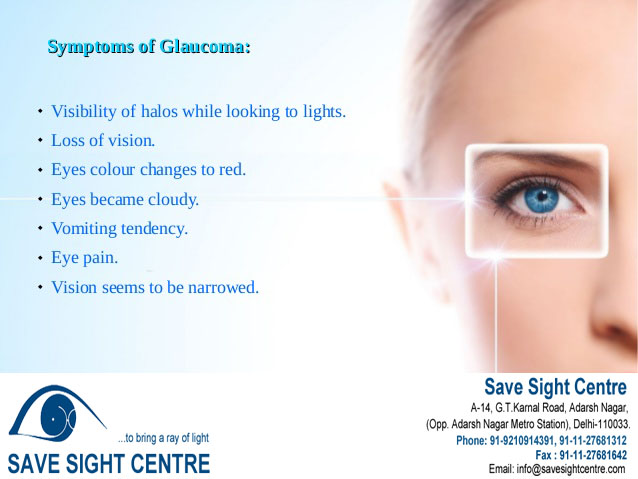
Glaucoma‬, often referred as ‘sneak thief of vision’, does not show any clear sign till the patient is on verge of losing ‪‎eyesight‬. In the initial phase, there is no pain or difficulty is seeing. But as the condition progresses, the patient gradually starts losing peripheral vision‬. Some symptoms that may be pointing towards Glaucoma are difficulty in seeing in dark places, frequent changes in eye power, narrowing of field of vision, blurred vision, seeing halos around light, pain and redness in eyes, nausea, change in the color of iris, watery eyes, double vision etc.

Tuesday, 10 May 2016

Why do one develop Glaucoma?

The main reason behind development of Glaucoma‬ is increase in intra-ocular pressure (the pressure of fluid in our eyes). Excessive rise in pressure strangles the nerve fibres, due to which they start dying. As a result, progressive damage occurs which may lead to permanent blindness.

But it is not the sole reason; Glaucoma can occur even if the intraocular pressure is normal. This is called Low-Tension or Normal Tension Glaucoma‬, in which optic nerve damage may occur due to other reasons. Though rare, Glaucoma can also be caused due to a chemical or blunt injury, eye infections, severe eye inflammation or blockage of blood vessels in eyes. 

Monday, 9 May 2016

Glaucoma can cause permanent blindness: Know about it

Glaucoma‬ is one of the leading causes of blindness‬ all over the world. Though people of every age group are equally susceptible to developing Glaucoma, for elderly, the chances are even higher.
 

Glaucoma is a condition in which the optic nerve, which transmits the images formed on retina to the brain, starts getting damaged. Once it is completely impaired, the brain stops receiving the images. As a result, the affected person loses his/her ability to see. 

Monday, 7 March 2016

High pressure in your eyes can cause Glaucoma

These days health related weeks are becoming common. Though there is a bit of marketing involved in these but at the same time, these help in spreading important awareness on health issues. This week is being observed as “Glaucoma week”. The objective of this is also the same and that is to spread awareness on how to prevent Glaucoma. As a silent sight thief, it does not give the person a chance to recover. And in a country like India, Glaucoma is one the biggest reason of blindness among adults. So,  it becomes important to understand its causes and ways to prevent it. It can be caused by high blood pressure, uncontrolled diabetes, injuries or some unexplained reasons. The patient himself can not detect the onset of Glaucoma but what can be done is that the moment person observes symptoms like an ache, redness, fall in vision, he or she should immediately consult an eye specialist. Especially those above 45 years should get an eye examination done as a matter of routine, once in six months.

Saturday, 31 October 2015

A healthy body makes for healthy eyes too!

Our eyes health depends largely upon our body's overall health. Having a good diet accompanied with regular exercise helps increasing body's blood circulation, which ultimately lowers down pressure in the eyes. Excessive pressure on the eyes is a major factor that contributes to Glaucoma, so exercising regularly can be extremely beneficial for your eyes.

Monday, 17 August 2015

Does fluid builds up in the front part of your eye? It can be Glaucoma


Glaucoma is one of the diseases of the eye that damages the eye's optic nerve. It usually happens when fluid builds up in the front part of the eye and this extra fluid which builds up in the front part of the eye, increases the pressure in the eye, damaging the optic nerve.

The optic nerve is connected to the retina — a layer of light-sensitive tissue lining the inside of the eye — and is made up of many nerve fibers, like an electric cable is made up of many wires. The optic nerve sends signals from retina to the brain, where these signals are interpreted as the images we see.

In the healthy eye, a clear fluid called aqueous humor circulates inside the front portion of the eye. To maintain a constant healthy eye pressure, eye continually produces a small amount of aqueous humor while an equal amount of this fluid flows out of the eye. If a person is suffering from glaucoma, the aqueous humor does not flow out of the eye properly. Fluid pressure in the eye builds up and, over time, causes damage to the optic nerve fibers.


Glaucoma can often be caused by another eye condition or disease. It can be caused due to eye injury, inflammation of the eye, abnormal blood vessel formation from diabetes or retinal blood vessel blockage, use of steroid-containing medications.
There are several types of glaucoma like
But the most common type of glaucoma is open-angled glaucoma while congenital glaucoma is a rare type of glaucoma that develops in infants and young children. It can be hereditary, and it happens when the eye’s drainage system doesn’t develop fully or correctly before birth.

Symptoms of an acute attack include:
  • Vision is suddenly blurry
  • Severe eye pain
  • Headache
  • Nausea
  • Vomiting
  • Rainbow-colored rings or halos around lights.
Glaucoma can be treated with eye drops, pills, laser surgery, traditional surgery or a combination of these methods. The goal of any treatment is to prevent loss of vision, as vision loss from glaucoma is irreversible.